UI / UX Design

Ward Task Orchestrator
A nursing task management dashboard designed to streamline ward workflows, prioritize patient care tasks, and improve team coordination.
Year :
2026
Industry :
HealthCare
Duration :
1 Week
Role :
UX Researcher · Product Designer
Client :
The VibeCoding Games
Type :
SaaS / Internal Tool

Problem :
Hospital nurses manage multiple time-sensitive responsibilities simultaneously, often relying on memory, handwritten notes, and fragmented systems. In Tier 2 and Tier 3 hospitals, staffing constraints and manual coordination increase cognitive load, making it harder to maintain situational awareness.
This can lead to missed tasks, delayed interventions, and inefficient shift handovers. The challenge wasn't a lack of information, but the lack of a structured way to manage it.

Solution :
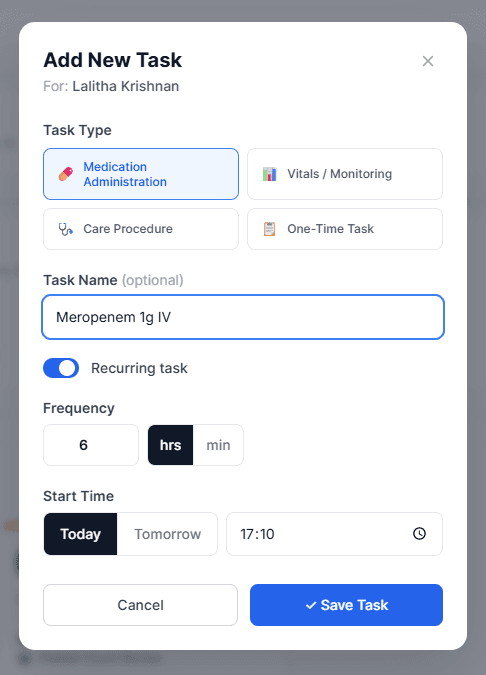
I designed a task-first ward orchestration system that surfaces responsibilities based on urgency rather than buried within patient records. The system organizes tasks into priority buckets, links them to patients and shifts, and generates structured handover summaries.
By making work visible and actionable, it reduces reliance on memory and improves operational clarity during busy ward shifts.

Challenge :
The biggest challenge was defining the right scope. Initially, I explored the entire nurse, patient, and doctor ecosystem, but quickly realized it was too broad for a focused solution.
I narrowed the problem to task coordination from a nurse's perspective and balanced simplicity with functionality within a rapid design sprint. Every design decision had to prioritize cognitive clarity over feature richness.
Summary :
Ward Task Orchestrator is a concept exploring how workflow-first design can reduce cognitive load in high-pressure healthcare environments. Instead of redesigning medical records, it restructures how tasks are surfaced, prioritized, and handed over across shifts.
The project demonstrates my approach to solving complex operational problems through research, systems thinking, and human-centered interaction design.

More Projects



UI / UX Design
Ward Task Orchestrator
A nursing task management dashboard designed to streamline ward workflows, prioritize patient care tasks, and improve team coordination.
Year :
2026
Industry :
HealthCare
Duration :
1 Week
Role :
UX Researcher · Product Designer
Client :
The VibeCoding Games
Type :
SaaS / Internal Tool
Problem :
Hospital nurses manage multiple time-sensitive responsibilities simultaneously, often relying on memory, handwritten notes, and fragmented systems. In Tier 2 and Tier 3 hospitals, staffing constraints and manual coordination increase cognitive load, making it harder to maintain situational awareness.
This can lead to missed tasks, delayed interventions, and inefficient shift handovers. The challenge wasn't a lack of information, but the lack of a structured way to manage it.
Solution :
I designed a task-first ward orchestration system that surfaces responsibilities based on urgency rather than buried within patient records. The system organizes tasks into priority buckets, links them to patients and shifts, and generates structured handover summaries.
By making work visible and actionable, it reduces reliance on memory and improves operational clarity during busy ward shifts.
Challenge :
The biggest challenge was defining the right scope. Initially, I explored the entire nurse, patient, and doctor ecosystem, but quickly realized it was too broad for a focused solution.
I narrowed the problem to task coordination from a nurse's perspective and balanced simplicity with functionality within a rapid design sprint. Every design decision had to prioritize cognitive clarity over feature richness.
Summary :
Ward Task Orchestrator is a concept exploring how workflow-first design can reduce cognitive load in high-pressure healthcare environments. Instead of redesigning medical records, it restructures how tasks are surfaced, prioritized, and handed over across shifts.
The project demonstrates my approach to solving complex operational problems through research, systems thinking, and human-centered interaction design.
More Projects
UI / UX Design
Ward Task Orchestrator
A nursing task management dashboard designed to streamline ward workflows, prioritize patient care tasks, and improve team coordination.
Year :
2026
Industry :
HealthCare
Duration :
1 Week
Role :
UX Researcher · Product Designer
Client :
The VibeCoding Games
Type :
SaaS / Internal Tool
Problem :
Hospital nurses manage multiple time-sensitive responsibilities simultaneously, often relying on memory, handwritten notes, and fragmented systems. In Tier 2 and Tier 3 hospitals, staffing constraints and manual coordination increase cognitive load, making it harder to maintain situational awareness.
This can lead to missed tasks, delayed interventions, and inefficient shift handovers. The challenge wasn't a lack of information, but the lack of a structured way to manage it.
Solution :
I designed a task-first ward orchestration system that surfaces responsibilities based on urgency rather than buried within patient records. The system organizes tasks into priority buckets, links them to patients and shifts, and generates structured handover summaries.
By making work visible and actionable, it reduces reliance on memory and improves operational clarity during busy ward shifts.
Challenge :
The biggest challenge was defining the right scope. Initially, I explored the entire nurse, patient, and doctor ecosystem, but quickly realized it was too broad for a focused solution.
I narrowed the problem to task coordination from a nurse's perspective and balanced simplicity with functionality within a rapid design sprint. Every design decision had to prioritize cognitive clarity over feature richness.
Summary :
Ward Task Orchestrator is a concept exploring how workflow-first design can reduce cognitive load in high-pressure healthcare environments. Instead of redesigning medical records, it restructures how tasks are surfaced, prioritized, and handed over across shifts.
The project demonstrates my approach to solving complex operational problems through research, systems thinking, and human-centered interaction design.